

In most cases, the ear examination findings are normal, MRI’s and CAT scans are normal.
TMJ ear pains can come from referred pain to one or both ears from stressed jaw muscles.
I deserve A pain-free life

BDS, MBBS, MMED
(Sleep Medicine)

Read about what our
clients think of us.
4.8★★★★★
273 Reviews

Parking Facility On Site
Above Town Hall Station

Claim From Health Funds.
Payment Plans Avaliable.

Advanced Technology with
Compassionate Service.
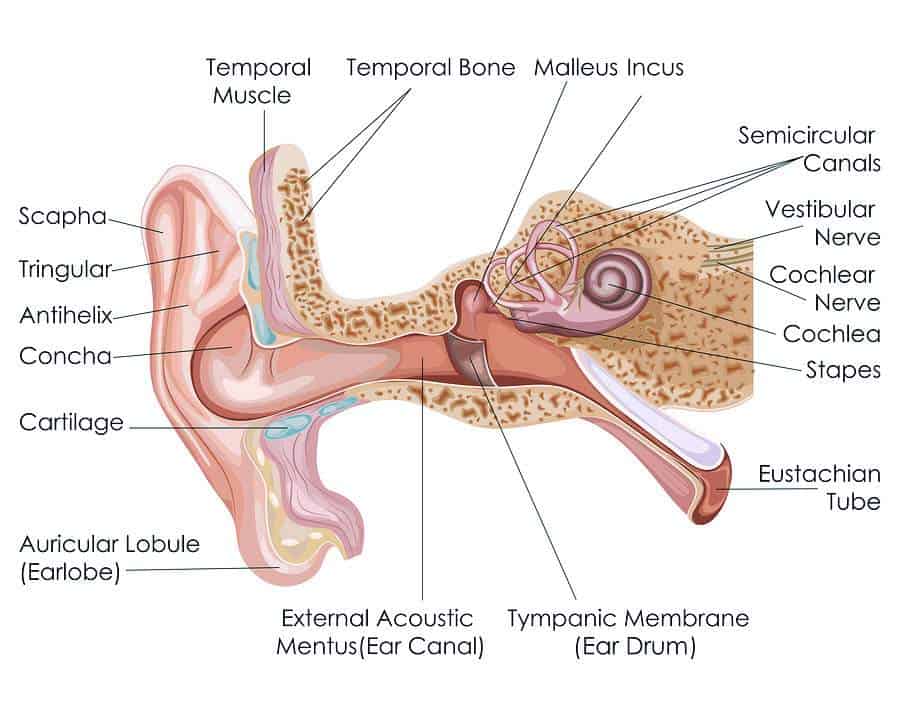
Ear pain and TMJ pain can be the first symptom of a TMJ problem.
Unfortunately, the first doctor that most patients see is not a dental but an Ear Nose and Throat physician.
In most cases, the ear examination findings are normal.
The problem is that physicians are not trained to diagnose dental and TMJ problems and many patients never get correctly diagnosed.
Many patients have made numerous visits from one physician to another and some have even been hospitalised by a neurologist.
They have MRIs and CAT scans and everything is normal.
It’s not uncommon for a patient to arrive in an emergency room with ear pain coming from the heart.
The same is true with referred pain from the chewing muscles.
If the chewing muscles dysfunction and hurt, the pain can be felt in the ears.
If the jaw muscles go into spasm and hurt, they can cause tightening of the surrounding muscles.
The inner ear has several muscles that can shorten and cause ringing in the ears and/or TMJ ear pain.
This TMJ symptom and many others often disappear in many patients after six weeks of TMJ treatment.
Many patients also have ringing in the ears and/or vertigo/dizziness from this problem.
Patients with TMJ problems often have a joint that is badly aligned and pushes backwards towards the ears.
The back of a human jaw joint has a lot of very sensitive tissue that hurts when it is compressed.
A patient’s body often tries to correct this problem by pulling the jaw joint forward and this takes muscle power.
Muscles were not designed to hold the bones in one place for a long time.
As a result, an overworked muscle that goes into spasm, begins to hurt, gets inflamed and begins to shorten and cause ringing in the ears.
Every other muscle in the area is usually affected.
A dental orthotic/appliance prevents a patient from compressing these tissues and therefore protect the tissues in the back of the joint.
The TMJ muscles then relax and this includes the muscles inside the middle ear that are related these ear problems.

The temporomandibular joints are located just in front of the ears.
Tenderness and deep pain in the TMJs and surrounding areas can often cause an ache and decreased hearing.
With time ringing in the ears (tinnitus) can occur.
Eventually, the middle ear can be affected causing vertigo or dizziness.
These problems along with combinations of other TMJ symptoms can cause difficulty sleeping (insomnia).
The jaw joints may have clicking and popping noises.
These are called TMJ noises.
This can progress to lock-jaw.
About 50% of patients with a TMJ disorder notice ear pain and do not have signs of ear infection.
The ear pain is usually described as feeling in front of or below the ear.
Often, patients are treated multiple times for a presumed ear infection, which can often be distinguished from TMJ disorder by an associated hearing loss or ear drainage (which would be expected if there really was an ear infection).
Because ear pain occurs so commonly, ear experts are frequently called on to make the diagnosis of a TMJ disorder.
Grinding, crunching, or popping sounds, medically termed crepitus, are common for patients with a TMJ disorder.
These sound may or may not be accompanied by increased pain.
Of patients with a TMJ disorder, 40% report a vague sense of dizziness or imbalance (vertigo).
The cause of this type of dizziness is not well understood.
About 33% of patients with a TMJ disorder notice ear-muffled, clogged, or full ears.
They may notice ear fullness and pain during airplane takeoffs and landings.
These symptoms are usually caused by eustachian tube dysfunction, the structure responsible for the regulation of pressure in the middle ear.
It is thought that patients with TMJ disorders have hyperactivity, (spasms) of the muscles responsible for regulating the opening and closing of the eustachian tube.
Grinding, crunching, or popping sounds, medically termed crepitus, are common for patients with a TMJ disorder.
These sounds may or may not be accompanied by increased pain.
Experts at the Sydney Centre for TMJ and Sleep Therapy specialise in treating sleep disorders and TMJ disorder.
Contact us if you are suffering from any symptom and we will carry out an extensive physical examination to diagnose the disorder and draft a suitable treatment plan for you.
Professional Memberships & Affiliations